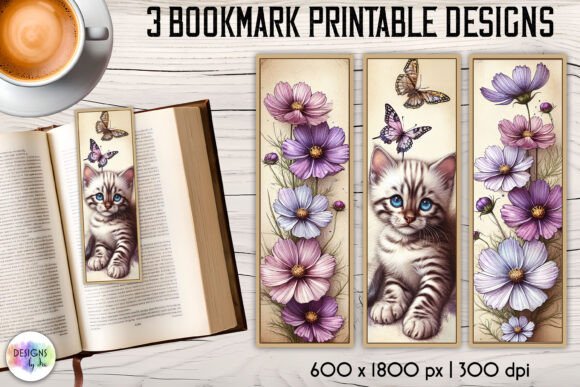
Vintage Floral Bookmark with Cute Kitten
First Impression: Delicate, Nostalgic, and Surprisingly Versatile
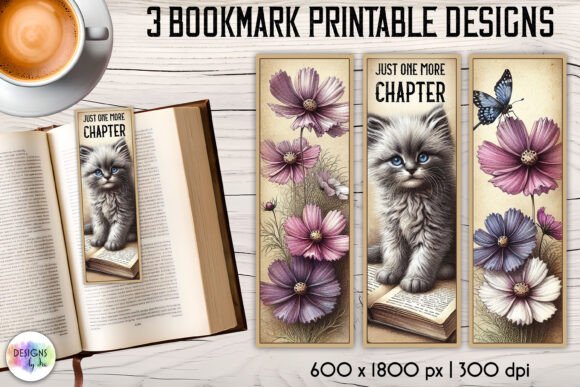
When I opened the Vintage Floral Bookmark with Cute Kitten, I didn’t see just another floral graphic—I saw a quiet moment of charm. The cosmos flowers are drawn with fine, curling stems and soft-petaled blooms; the kitten sits nestled in the composition like it belongs there, not tacked on. Its blue eyes aren’t cartoonish—they’re gentle, almost wistful. There’s no heavy outlining or aggressive contrast, which tells me this was designed for subtlety, not shouting. That matters deeply when translating a digital graphic into real embroidery.
Real-World Test: Stitching It onto a Linen Tea Towel for a Boutique Gift Set
Last week, I prepped a small batch of embroidered kitchen towels for a local gift shop—linen blend, medium weight, natural off-white. I chose Vintage Floral Bookmark with Cute Kitten as the focal motif for one design variant. Why? Because linen holds detail well but punishes over-dense stitching, and this design’s open layout gave breathing room between elements. The cosmos stems translated beautifully in running stitch, the kitten’s face held up in satin stitch with minimal fill, and the butterfly’s wings stayed legible even at 3.2 inches wide. Customers responded immediately—not to “cute,” but to *recognition*: “It feels like something my grandmother would’ve tucked into her favorite novel.” That emotional resonance is gold for handmade product storytelling.
Where It Shines (and Where It Needs Care)
Vintage Floral Bookmark with Cute Kitten works exceptionally well for:
- Small-format embroidery projects—think pillow covers, baby onesies, apron pockets, or cap brims—where scale and clarity matter more than bold impact;
- Personalized gifts like holiday stockings, nursery wall hangings, or wedding guest book covers, where softness and sentiment align with buyer expectations;
- Boutique merchandise and Etsy listings that lean into vintage, cottagecore, or literary aesthetics—its cohesive mood supports brand voice without needing extra styling;
- Printable mockups and digital product previews, since the line work and spacing render cleanly at multiple resolutions.
But here’s where attention is non-negotiable:
- Thin or stretchy fabrics—like lightweight cotton voile or jersey—will need cutaway stabilizer beneath and possibly topping for the kitten’s facial details;
- Dark fabric backgrounds demand careful thread color selection; pale pinks or creams may vanish unless paired with tone-on-tone satin stitch or subtle variegated thread;
- Curved surfaces (caps, mugs, curved tote handles) require repositioning the design to avoid distortion—especially around the kitten’s ears and butterfly wings;
- Frequent-wash items like baby bibs or tea towels benefit from tighter stitch density in the flower centers, but only if the original file allows safe adjustment—don’t force denser fills without testing first.
Design Integrity in Action
What makes Vintage Floral Bookmark with Cute Kitten stand out isn’t novelty—it’s restraint. There’s no unnecessary flourishes, no overcrowded corners, no micro-detail that vanishes under thread. That directly affects how your finished product reads: clean stitching builds customer trust, especially for Etsy sellers who rely on perceived craftsmanship. A poorly digitized version of this concept would blur the kitten’s whiskers or flatten the cosmos’ layered petals—but as a well-proportioned graphics set, it gives you room to interpret, not compensate.
I’ve used it in three commercial embroidery projects so far: a limited-run embroidered patch series for a children’s bookstore, a set of custom sweatshirt sleeves for a small press launch, and as a subtle corner motif on hand-stitched baby blankets. In every case, buyers commented on how “thoughtful” and “unforced” the design felt—not “designed to sell,” but designed to belong.
Practical Notes Every Embroidery Designer Should Check
Before cutting fabric or loading your machine:
- Test on scrap fabric—especially if using textured weaves or blends. Linen, chambray, and medium-weight cotton all behaved differently with the same stabilizer setup.
- Review stitch density. If the file includes fill stitches in the flower centers, confirm they’re not over 18–22% density—anything higher risks puckering on lighter fabrics.
- Confirm hoop size compatibility. This design fits comfortably in a 4×4 hoop, but check whether the tallest element (likely the cosmos stem) clears your machine’s frame clearance.
- Inspect small details—the kitten’s pupils, butterfly wing veins, and petal edges—under magnification before committing to production runs.
- Mock it in black and white first. Does the silhouette hold? Does the kitten read as friendly rather than sleepy or vague? Contrast is everything in stitch-based interpretation.
- Use proper stabilizer: tear-away for stable wovens, cutaway for knits or lightweight linens, and light topping for fuzzy textures like terry cloth.
- Verify licensing before selling finished items or reselling the digital embroidery file. Since this falls under Graphics in the Crafts category, commercial use rights aren’t assumed—always double-check terms.
Final Thought: Not Just a Design—A Quiet Confidence Builder
Vintage Floral Bookmark with Cute Kitten won’t dominate a tradeshow booth or trend on TikTok overnight. But it will earn repeat orders from customers who value quiet intention over flash. It pairs well with handwritten tags, kraft packaging, and unbleached cotton—materials that let the design breathe. For craft business owners building long-term loyalty, that consistency matters more than virality. When your Etsy listing shows a linen tote with this motif stitched just above the seam, and a buyer writes, “It feels like it was made for me,” that’s the real ROI. Not hype. Not volume. Just honest, well-considered design—stitched right.