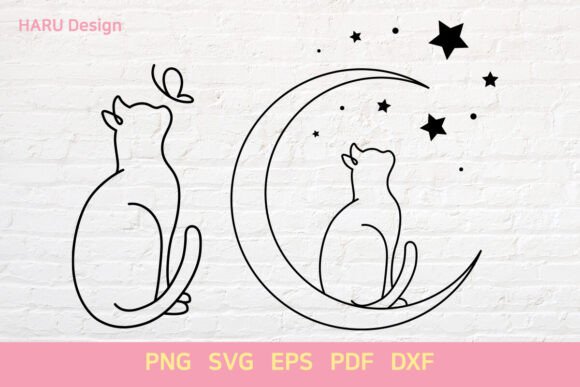
Moon Cat and Stars Butterfly Cat Outline
A Delicate, Dreamy Silhouette That Demands Thoughtful Execution
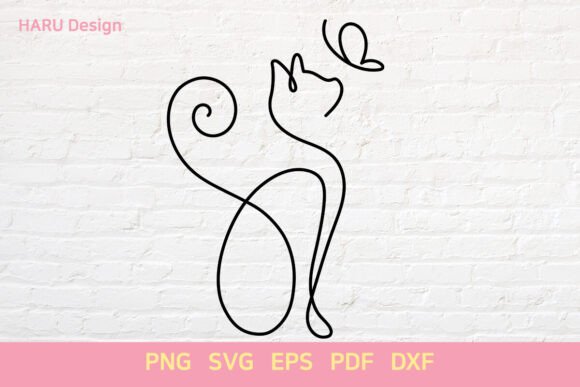
First glance at Moon Cat and Stars Butterfly Cat Outline lands softly—not with boldness, but with quiet charm. It’s a single-line contour drawing: a curled feline nestled beneath a crescent moon, flanked by scattered stars and a delicate butterfly wing echoing the curve of its tail. There’s no fill, no shading—just clean, continuous negative space waiting to be defined. As an embroidery designer who’s stitched hundreds of motifs for boutique baby onesies, linen tea towels, and custom sweatshirt patches, I immediately read this as *intentionally minimal*. It’s not lazy simplicity; it’s lyrical restraint. The mood is gentle, whimsical, and quietly magical—perfect for nursery decor, mindful gifting, or a small-batch apothecary brand. But that elegance comes with real-world embroidery caveats.
Where It Shines: Lightweight Fabrics, Thoughtful Placement, and Quiet Confidence
I recently tested Moon Cat and Stars Butterfly Cat Outline on a 100% cotton tote bag destined for a local indie bookstore’s summer launch. The result? Subtle, sophisticated, and unmistakably handmade. Because it’s purely outline-based, the design avoids heavy stitch density—no dense satin fills or layered appliqué. That means less stabilizer bulk, smoother drape on lightweight fabrics, and cleaner edges on flat surfaces like pillow covers or kitchen towels. On a soft organic cotton sweatshirt, the same motif stitched in matte black thread felt intentional and modern—not childish or cutesy. For Etsy sellers offering personalized baby embroidery, this works beautifully on swaddle blankets or bibs when placed near the shoulder seam, where the curve of the cat’s body follows natural fabric lines. It also translates well into printable mockups: the clean vector files (SVG, EPS, DXF) scale crisply, and the 12in×12in artboard gives ample breathing room for resizing down to 3–4 inches without losing legibility.
Where It Needs Care: Texture, Scale, and Surface Realities
This isn’t a design for every surface—or every client brief. On textured fabrics like terry cloth towels or bouclé knit caps, the fine line work risks blurring or disappearing between loops and piles. On stretchy fabrics (think ribbed baby bodysuits or performance tees), even light tension can distort the delicate curves of the butterfly wing or moon arc unless stabilized heavily—and even then, running stitch fidelity suffers. And on dark fabric? Without fill or shadow, contrast relies entirely on thread choice and stitch type. A pale ecru thread on navy denim may read as elegant—but only if your machine delivers consistent tension and your hoop holds true. I’d avoid placing it on highly curved areas like cap fronts unless resized to under 2.5 inches and tested thoroughly. Tiny corners—like the tip of the butterfly’s wing or the inner curve of the crescent—can fray or skip if stitch length isn’t optimized for fine detail.
What This Means for Your Craft Business
As a small shop owner or Etsy seller, Moon Cat and Stars Butterfly Cat Outline adds quiet value—not flash. It signals attention to detail, not volume. Customers browsing handmade embroidered patches or personalized gifts respond to its calm confidence: it feels curated, not mass-produced. That builds trust, especially in niches like mindful parenting, slow living, or botanical-themed home goods. But it won’t drive impulse buys the way a vibrant floral fill stitch might. Its strength lies in cohesion: pair it across product lines (a pillow cover + matching tea towel + baby blanket set), and it becomes part of a recognizable brand language. Just remember—its subtlety means presentation matters more. A poorly hooped or low-contrast stitch will look unfinished, not minimalist. That directly impacts perceived value and buyer engagement.
Practical Designer Notes Before You Stitch
- Always test first—on scrap fabric matching your final project’s weight, weave, and stretch.
- Check thread color contrast in natural light and under store lighting; what reads softly in daylight may vanish on screen mockups.
- Review stitch type: running stitch works best for pure outlines, but confirm your embroidery file uses appropriate stitch length (2.0–2.8mm is ideal for clarity without fragility).
- Confirm hoop size compatibility—the 12in×12in artboard suggests flexibility, but resize carefully for smaller hoops (e.g., 4in×4in for caps or baby items).
- Inspect small details in both vector and raster previews (PNG/PDF)—look for unintended breaks in the line, especially where stars meet the cat’s outline.
- Test black-and-white mockups to assess silhouette strength before committing to color.
- Compare light vs. dark fabric backgrounds—this design lives or dies by contrast, not complexity.
- Use cutaway or tear-away stabilizer appropriately: lightweight for stable cottons, medium-weight for knits.
- Verify licensing terms before selling finished embroidered products or digital embroidery files—Moon Cat and Stars Butterfly Cat Outline is listed as Graphics within Crafts, but commercial use rights must be confirmed directly with the source.
Final Thought: A Design That Rewards Intention
Moon Cat and Stars Butterfly Cat Outline won’t shout from a craft fair table—but it will linger in memory. It suits makers who understand that sometimes, the most powerful statement is a whisper: a single line tracing wonder onto fabric. Use it where quiet intention matters—on a hand-stitched holiday gift, a boutique apron for a herbalist, or a personalized baby embroidery set meant to grow with the child. Just respect its delicacy. Choose fabric, thread, and placement with care. And always, always test. Because in embroidery—especially in handmade product and custom apparel—the difference between “charming” and “barely there” is measured in millimeters, tension, and attention.